

I once watched Paul Daniels, the famous British magician, on British television do something I’ve never forgotten.
He took a five pound note and, with his bare hands, ripped it to pieces in front of us. Not cut. Ripped. Bit by bit, until there was nothing left that you could spend.
Then he folded the pieces up, unfolded them, and the note was whole again.
The same note. No tears. No tape. Completely restored.
I’m no professional magician. I just dabble badly. And my family would confirm this.
But that picture is the shape of a book I’ve written, called Torn and Restored. First, the tearing. Then, the restoring.
I KNOW WHAT TORN FEELS LIKE
I keep meeting people who are being torn in two.
They love God. They work hard. They turn up on Sunday and again on Monday. And somewhere between the two, they are coming apart.
Maybe you are one of them. I certainly was.
In 2004 I was very near to a breakdown. I was trying to help a church leader with a difficult area of the church. Work was hard, and I was trying to prove myself. At home, my wife had just lost her father. One of my leaders and pastors said to me, famously, “Ian, the man who stands in the middle of the road gets hit by both sides of the traffic. You need to realise this is happening to you.”
I didn’t completely buckle. But I did withdraw, quite badly. For about six weeks I was very tearful, and I didn’t know why. I didn’t want to go to church. I didn’t want to talk to anyone, including my lovely wife.
I had reached the point where one word summed me up. Torn. Torn and tired.
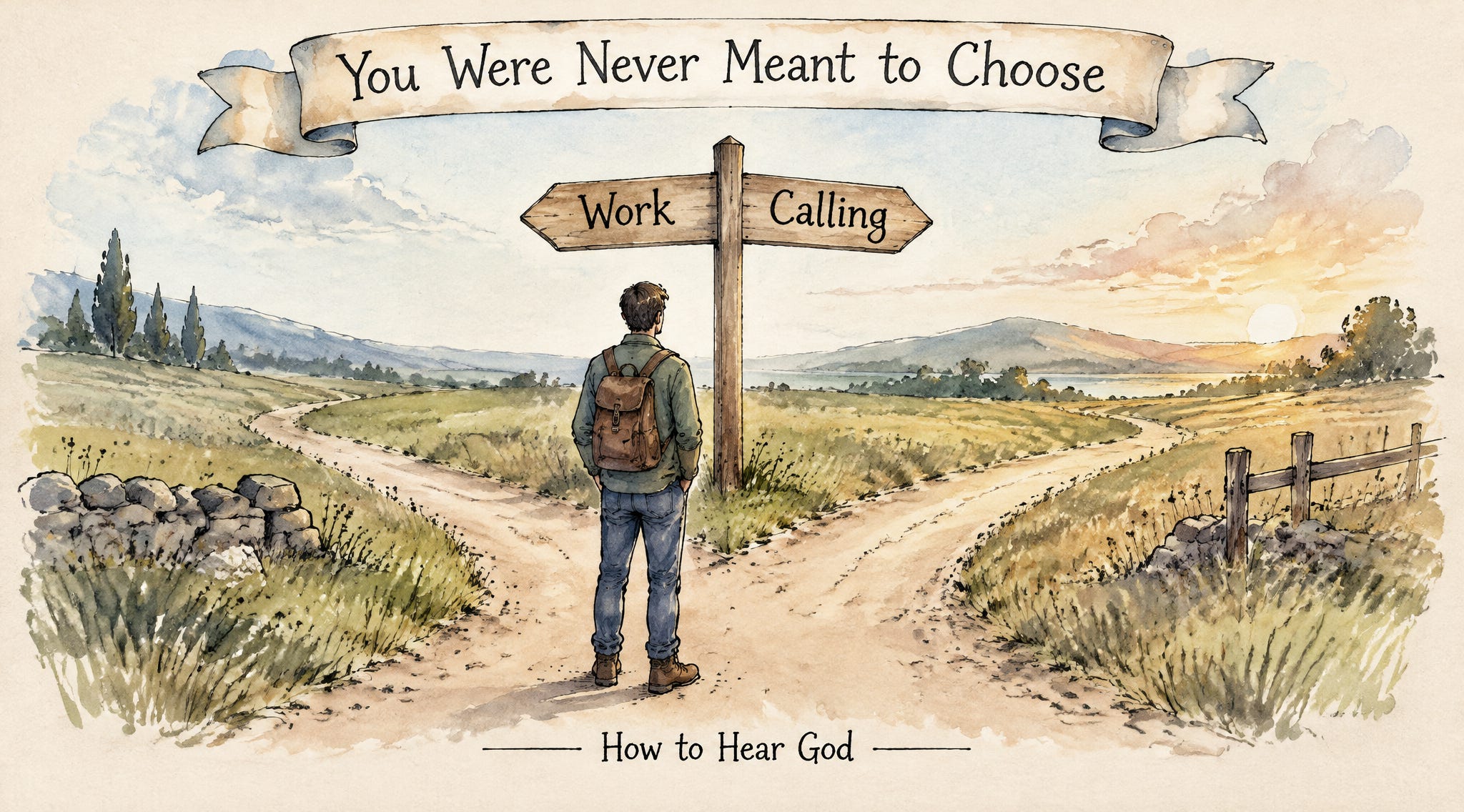
YOU WERE NEVER MEANT TO CHOOSE
Somewhere along the way, many of us were taught that work is one thing and calling is another. That faith lives on Sunday and the job lives on Monday. That you have to pick.
That division was never real. Being torn is not the same as sinning. It’s what happens when one life gets pulled in too many directions.
Paul puts it like this: “I therefore, a prisoner for the Lord, beg you to lead a life worthy of the calling to which you have been called.” (Ephesians 4:1)
Walk. Every day. Not just on Sunday.
Here’s the whole idea in one sentence: you were never meant to choose.
I’ve never been able to explain that without telling a story first. It’s about the worst dancer in England.
THE WORST DANCER IN ENGLAND
That was me.
Sometime in my early twenties, in a city I was still learning to call home, I was a student with very little money, still far from God and further still from any idea of what my life was for. And by some extraordinary stroke of fortune that I’ve never been able to explain, I was about to take the most beautiful woman I’d ever seen to a disco.
I should be clear: I couldn’t dance. This wasn’t false modesty. It was a structural problem. Other people seemed to have an inner mechanism that turned rhythm into movement. I didn’t have it.
So I asked someone who could help. My friend told me to imagine I’d just stepped out of the bath and was towelling myself dry, and then to imagine I was pointing at the stars. I practised both in my room.
Sometimes it’s good to spoil a story. I didn’t know then that she would become my wife, give me two wonderful boys, and be the launchpad for all my ministry. But that’s another story. Back to the queue.
The doors opened and we went in. It wasn’t glamorous. It was a box: a square room with tall walls and dark lights that turned everything purple. The floor was packed. The music was so loud it seemed to have weight.
And I couldn’t see anything.
I mean that literally. Surrounded on every side, I could see perhaps two or three feet in any direction. I was, in my own opinion, contributing a great deal to the evening, doing my best impression of a man who had stepped out of a bath and was pointing at the stars. And I was completely, thoroughly lost.
THEN I SAW THE STAIRCASE
On the side of the room there was a narrow staircase going up. At the top of it was a balcony.
I went up. And everything changed.
From the balcony I could see the whole floor. I could see her, dancing near the far wall. I could see my friends. I could see the bar. Same room. Same people. Same music. But from up there I wasn’t lost any more. I could see.
Then I went back down. And here’s the thing this whole book is built on: I went down differently from how I came up. I went down with a map in my mind. I moved through the same crowd, in the same dark room, with the same bodies pressing in on every side. But now I had direction. Now I could find what I was looking for.
WHAT THE DISCO STANDS FOR
The disco isn’t the point. It’s just a room I happened to be in once, as a young man with too little dancing ability and too much confidence. What it stands for is the point.
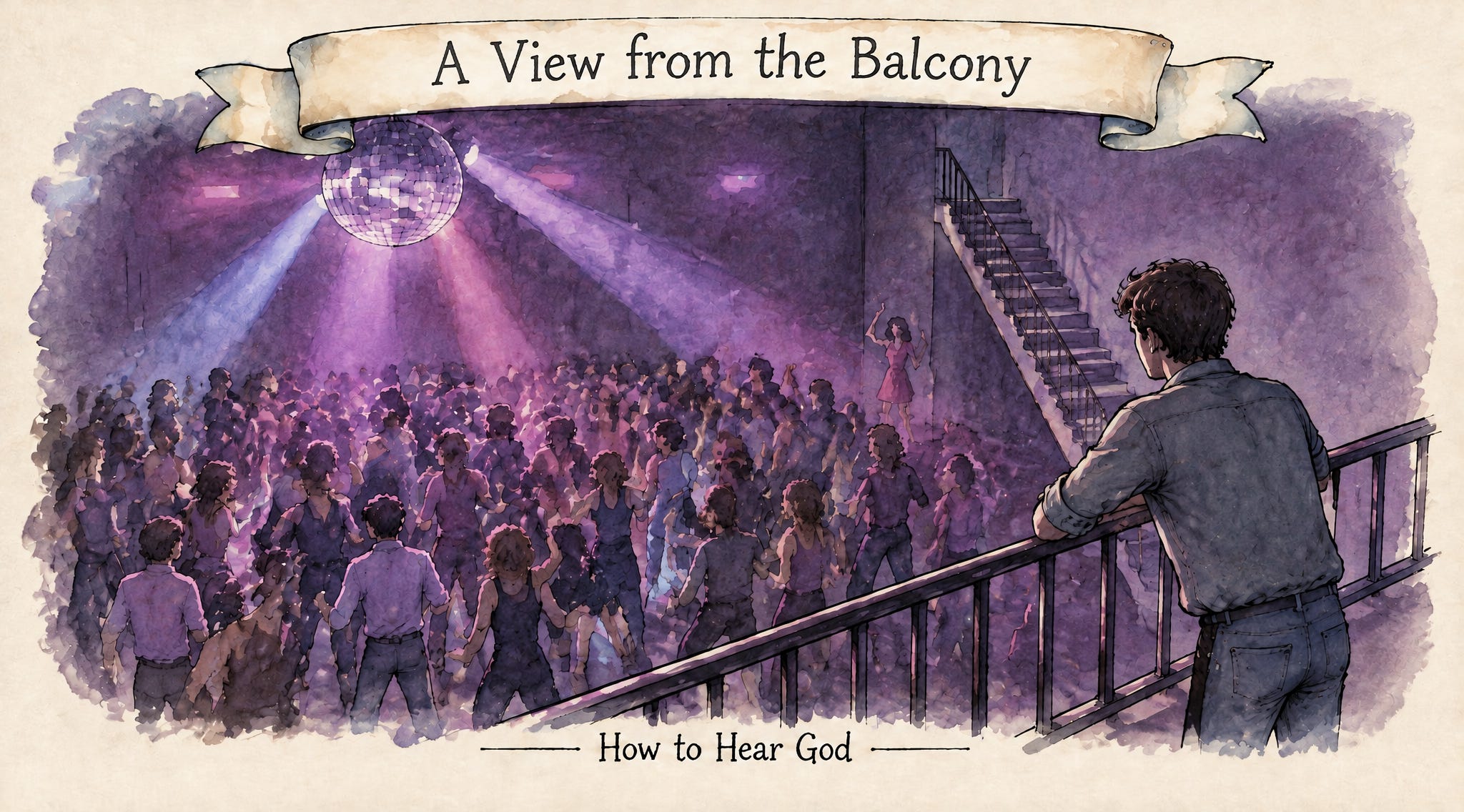
That crowded, loud floor, where you can see two feet in any direction and no further, is the world of work. The office, the shop, the care home, the building site, the school, the trading floor. Most of us spend most of our waking hours there. And many believers have been told, plainly or by hint, that it’s not quite where God’s real work happens.
The balcony is the view from above: the ability to see what’s really going on in that room, and where things are heading, and then to come back down with a map. In the Old Testament, one group of men is remembered because they “had understanding of the times, to know what Israel ought to do” (1 Chronicles 12:32).
None of this is mystical floating above real life. It’s walking into a negotiation, a classroom, a ward or a team meeting and seeing it from above. It’s having a map before you go back down.
YOU DO NOT HAVE TO EARN THE VIEW
If the balcony view is available, and I believe it is, why are so many called, praying people still pressing through the crowd on the floor?
The book of Proverbs says: “The purpose in a man’s mind is like deep water, but a man of understanding will draw it out” (Proverbs 20:5).
There’s deep water in you. I don’t doubt that. The question is why it’s not being drawn out.
I’ve sat with people who carry something extraordinary, a quality their CV can’t explain, and watched them do everything the floor tells you to do when you’re getting nowhere. Apply harder. Network further. Polish the pitch. The answer is nearly always something on the floor.
Very rarely do they look up.
The balcony isn’t a prize for the specially gifted. James writes: “If any of you lacks wisdom, let him ask God, who gives to all men generously and without reproaching, and it will be given him” (James 1:5).
The view from above is a gift to ask for, not a qualification to earn.
So the problem isn’t that you’re unqualified. The problem is that someone told you the staircase wasn’t for people like you.
I heard versions of this for fifteen years, from people I respected and loved. Many of them were good people, and some of them were right for themselves. There are people whom God calls into full-time church ministry, and that’s a fine calling. The mistake is to say that everyone with a serious calling must do the same.
I prayed about it. And I kept hearing the same answer: both.
TWO TRIBES BLESSED TOGETHER
At the heart of this is an old picture, spoken by Moses at the end of his life. He gathers the twelve tribes and blesses them one after another. Then, when he comes to two of them, he does something he does for no other tribe. He blesses them together.
“And of Zebulun he said, ‘Rejoice, Zebulun, in your going out; and Issachar, in your tents. They shall call peoples to their mountain; there they offer right sacrifices; for they suck the affluence of the seas and the hidden treasures of the sand.’” (Deuteronomy 33:18-19)
Issachar is the tribe remembered for understanding the times. Think of the balcony. Zebulun is the one who goes out: trading, travelling, working in the busy, practical world. Zebulun is in the crowd.
Notice what Moses doesn’t say. He doesn’t say to Zebulun, “I suppose your trade is acceptable.” He says rejoice. He doesn’t say to Issachar, “Your spiritual life is admirable but rather impractical.” He says rejoice. Both callings are honoured, and both are blessed together.
I should be honest about how I’m using this passage. The text blesses two tribes together. I’m reading them as a picture of two things that belong together: seeing what God is doing, and the practical work of getting things done in the world.
In that world the sea was the great trade route, and the sand held the resources economies were built on. Here’s what I take from the picture. There are things in your own field that you can’t reach by skill alone. And there are things that prayer alone, without any presence on the floor, can’t deliver either. Together, they can.
REST IS NOT FAILURE
This is not a promise that faith will make you rich. There are seasons when the view from above is clear and the floor is still hard.
And just to be clear, rest and resting isn’t failing. When God says it’s time, he brings a field back to life. That’s the one thing I’d like you to carry with you, and it comes from the prophet Hosea:
“Sow for yourselves righteousness, reap the fruit of steadfast love; break up your fallow ground, for it is the time to seek the Lord, that he may come and rain salvation upon you.” (Hosea 10:12)
There are times to rest some areas of your life and your ministry. If you rest at the right time, God’s time, you can come back later even stronger. I’ll come back to that in the next piece. I had to learn it the hard way in 2004.
You won’t do it all at once. Nobody does. But you can start today.
A FIRST STEP
If you have five quiet minutes, put your phone face down.
Ask. Pray James 1:5 in your own words. Lord, I lack wisdom. Please give it, generously and without reproaching.
Then look at your week. Where are you still on the floor, seeing only two feet in front of you? And where might you go up?
Something is being formed in you that’s too big for the room you’re in.
The staircase is still there.
I walk this out more fully in my book Torn and Restored, a seven day plan for when you’re near to worn-out. You’ll find my books at https://books.ianbanner.com.